Saturday, July 21, 2018

The Shore Club


Clubhouse and Gazebo behind the first tee.
By Steve Gordon

Recently I had the privilege to revisit and play a round of golf at The Shore Club, formerly the Wildwood Country Club. After the round my playing partners and I found it to be exactly what Director of Golf Fred Riedel said it was, “a fun golf course to play.”

With the new ownership and physical upgrades to the clubhouse, the 18-hole Wayne Stiles golf course that opened in 1921 isn’t getting overlooked. It’s gone through some changes over the years including the major loss of four holes in 1952 when the Garden State Parkway expanded. But through that and the addition of new holes and the rerouting of the course, it has maintained itself as a quality layout.


Work has started on the bunkering but also tree removal is on the agenda. Many golfers like well defined tree lined golf courses but there is a point when trees become obstructions over the character of a golf hole. Eleven and twelve are two replacement holes that fall into that category along with not really having quite the same look and feel as the rest of the course.  


Reidel explained that for a couple years after those holes were built they weren’t used because there were issues of turf conditioning. Those issues were resolved and the holes were incorporated into the course and they are good golf holes. However now there is a plan to make them fit in better with the rest of the course.


The plan begins with shortening the 441 yard par 4 (members white tees) 12th hole to about a 360 or 370 risk reward par 4. Then the heavily tree lined left side between it and the 11th hole will be mostly cleared to give it more of an open feel. The end result will be a shorter hole that will retain the water hazard guarding the front of the green and a large specimen tree guarding the dogleg.  


The preceding 360 yard par 4 eleventh hole is likely to remain as is with some tree removal. However Reidel indicated that there are some at the club who would like to rework it to make it a par 5. This would retain the course as a par 72, but that is a minor issue for this golf director.  The hole is a challenge as it is as the sixth rated handicap hole on the course. 

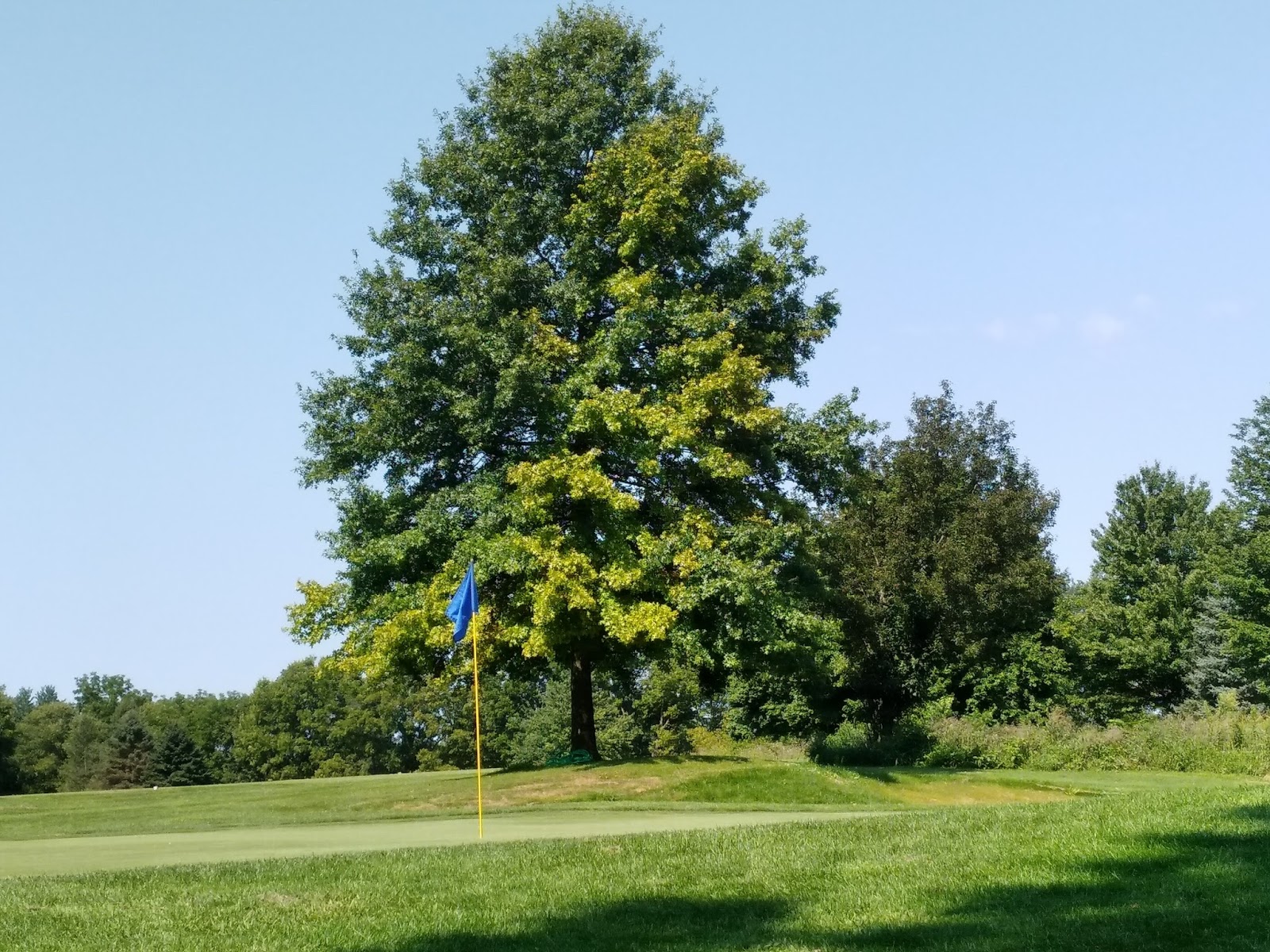
As shown above the wind will stretch out the flag sticks around the course. 


As for the bunkering, the biggest and most noticeable part of the makeover for members, it has started on holes three and seven. “Primarily the bunkers will be rebuilt and the style will be consistent throughout the course,” Riedel explained. “The floor of the bunkers will be relatively flat and the sod will be rolled down to the bunker much like what was here before,” he continued. Holes five and six are next to be done in the ongoing cycle.


On our trip around the golf course we found a nice mix of long and short holes in a combination of straight and tricky doglegs. Also there were two par 5 holes in two and fifteen that we (as mid-level handicappers) found were reachable in two having some favorable wind and slightly forward tee placements. It required two good shots of course.

Reidel cited the 15th hole a favorite of his and a lot of his reasoning has to do with the green. “It has a lot of character,” he commented in addition to the challenge of negotiating the way to the green sandwiched between unplayable areas down the left side and a water hazard in play on the inside of the slight dogleg. Wind is a big factor in coastal golf courses and Reidel said he has seen the 15th play really tough and long and getting on the green in regulation can be a challenge.

Add 15th green as seen from the right side of the fairway.
Risk reward holes dot the course for the long hitters with strategic placement of water hazards, bunkers and sharp doglegs. In general we found just pulling out the driver wasn’t the way to play some of them which followed another thing Reidel commented on after our round. “If you play smart and hit to the middle of the greens you can do well here,” he told us.


One thing players will remember are two par three holes in five and sixteen, both play over water. While they are mild yardage holes playing 133 and 121 yards from the white members tees (170 and 155 from the back tees) you can walk up on the tee with three clubs in your hands and stand there trying to figure out which would be the right one because of the wind conditions on any given day.
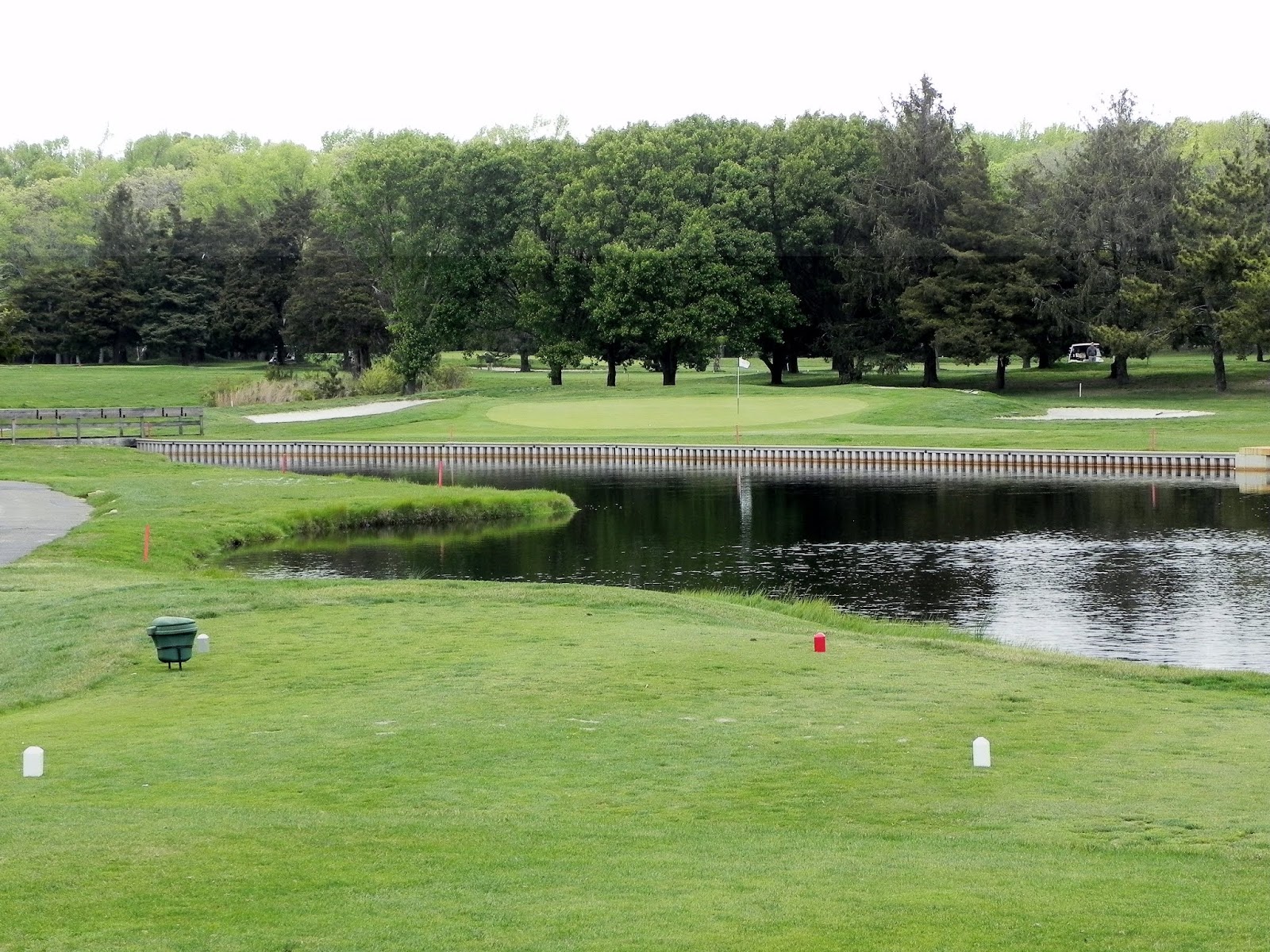
Par 3 5th hole.

Par 3 16th green as seen from 15th fairway.


“There really is no prevailing wind,” Reidel said. It can be a North or Northwest wind or it came come up from the south, and then there is the east wind coming in off the ocean. Add to that the infamous Jersey shore green heads. “We don’t have bugs all the time,” Reidel said and added that the winds can and do help with the bugs.


The course record was set a few years ago by a then 19-year-old local player, Alexander Hicks, who is now chasing the dream on the Canadian tour. “He came in one day with a score of 64 which would have broken the existing course record,” Reidel said, “but one of the holes was set up short so it really didn’t count. About a month later he came in with the 62.”


The Shore Club is private but there are seasonal memberships and you can call Amanda Ruhl at 609-465-7824 to explore the options available.


View from clubhouse patio of the current 7th green.
(photos by Steve Gordon)

Saturday, June 30, 2018

Score better

By Steve Gordon

I work as a starter a couple days a week at a local golf club and I hear the talk regularly as I chat with the players as they prepare to tee off. You know, the plan on how they are going to score better with a better short game, make better putts, etc. as the friendly bets are made for the round.

Then as I am out on the course to marshal play I see first hand how scores are raised by various blunders that weren't planned.

Score is important as it is a bench mark of how we performed on a certain day. The other side of that coin for me is that fixation on score can ruin a good walk as opposed to the Mark Twain quote that "Golf is a good walk spoiled."

What I want to put in front of you here is to present ways you can potentially score better WITHOUT taking a lesson or hitting the ball better. There are many facets of this game to master to play well to score better. Drive for dough, putt for show but what happens in between? Sure, the efficient repeatable swing is the most sought after goal but it isn't the end all.

SO my fellow golfers, what if I told you there is a way to score better hitting the same assortment of tops, pop ups, worm burners, skulls, slices, hooks, shanks, etc.? Those shots are usually followed by talking to yourself or a playing partner on what went wrong. Things like coming out of the shot, not keeping the head down (one of the worst pieces of advice ever), half swing, too big a swing, trying to kill it, etc.

How many of you have heard (and said) that perhaps the most important part of learning the game and playing well (and scoring better) relies on that six inches between your ears?

We have all done things on the course to waste shots so going back to my opening line of what I see regularly let's think about what we do out there outside of the first tee shot in front of an audience wanting to show off your game or trying not to embarrass yourself. No pressure there, right?

The hard fact is that it is so simple and yet so many of us don't take advantage.

It can start with the tee shot with alignment on the occasion that you will hit that driver in the sweet spot and end up in the trees or worse. Not all tees are aimed directly down the hole (on purpose is some cases as part of a design). I watch players line up and aim left or right but think they are aligned to go down the middle.

What I want to hit on however are those hero shots. The ones envisioned that rarely if ever come off and are low percentage.

1. Your best shot might be 200 yards off the tee (the USGA says the average male bogey golfer hits his drive 180-200 yards). In your head is this majestic high and long tee shot down the middle of the hole and just last weekend I saw a group of players who thought they hit it better than they did and all it did was cause them frustration and slow up play thus frustrating all the players behind them. Let's call this playing within yourself. Just take that swing that hits the fade, slice, draw, hook or the shortish but straight shot and go from there. Anything other than that is likely to result in something far worse and potentially cost you a stroke or two on the scorecard.

2. The same approach works from the fairway with the player who is 250 yards out and is afraid he might hit the people on the green. This is more of  a pace of play thing but a really bad shot trying to hit it too hard could cost you.

3. I think the most defined of shots that costs strokes comes when players try to hit it through a hole in the trees the size of a car window. When in the trees or very deep rough just accept it get it out, even if you have to hit backwards or sideways. In the end trying the hero shot is going to cost at least one on your scorecard. Same thinking goes for deep fairway bunkers.

4. Around the greens don't try to hit the Phil flop shot. The odds are long that you will pull it off and end up in the same spot or a worse spot. Another lost stroke.

5. On the greens don't try to make everything, especially those 60 footers. Good putts are hit with the correct speed, great putts have speed and line. The line is easier to get than distance so having say a one or two foot putt is a lot easier and potentially makeable than perhaps a six, or eight foot putt that didn't get to the hole or ran past it.

Do I practice what I just put out here. I'd say I have a very high percentage and a higher percentage when playing with my longtime golf partner who keeps me in line. Am I a scratch golfer? Nope, but I have learned how to save making unnecessary scores.

Thursday, May 24, 2018

Course Review - Crossgates

By Steve Gordon

The road trips to find new golf courses are getting longer as my golf partner and I seek out venues outside the ones we have played many times. As Group Golfer comes up with attractive offers to play new courses for reduced rates we are always on the lookout for a new road trip. And that is how we found Crossgates Golf Club in Millersville, PA.

Opened in 1994 the course sits within a community of single homes and townhouses on rolling terrain. It appears that course architect Ferdinand "Fred" Garbin (1928-2009) was thinking of senior players when he laid out his design. Residents of the community get discounted rates after an initial free one year membership after purchase of a home.

Garbin is a Penn State graduate and has over a dozen designs to his credit in central and western Pennsylvania as well as a few in Ohio, West Virginia and Virginia. He learned the craft working with James G. Harrison who is a student of Donald Ross and Garbin was involved in the redesign/restoration of several Ross courses in Pennsylvania.

Former mini tour player Jared Tester holds the course record of 63 breaking the previous record of PGA tour pro Jim Furyk by one stroke.

It starts out with a downhill tee shot on the 321 yard (white tees) opening hole that doglegs left back uphill to the green. This hole gives you an idea of what you are in store for. Accuracy is paramount over length. After the 389 yard second hole all but one of the par 4 holes are 340 or less from the white tees and even from the back tees there are no par 4's over 400 yards after the second hole.

First hole from behind the green.
Because of the length and design of the holes long drives can get you in trouble. There is out of bounds on every hole but the third but that holes has it's own set of boundaries set against the Conestoga River. Also 10 holes have lateral hazards on them and yellow staked water hazards exist on four holes.
The 118 yard (136 yards from the back tee) par 3 hole.
Crossgates is a very playable golf course but some holes need to be seen to understand how to play them like the par 5 fourth hole which is almost a horseshoe shape around a heavily treed hill on the inside and the River on the left on the outside of the hole. After getting a solid tee shot on the fairway you do not have a sight line to the green. A relatively easy layup shot to the left center of the fairway will leave a wedge to the pushed up green. For me it's a hole I would have liked to play over having seen it.

There is a nice collection of par 3 holes headed up by the aforementioned third hole pictured above. While three is short you have to hit the green or favor the right side and maybe get a kick off the hill. Anything short is trouble and anything left and long is likely a reload. It was my favorite and most memorable hole on the course.

The greens are basically average size and mostly flat with little rolls and subtle tilts that if you don't read properly you will have putts veering away from the hole. I had one putt that for sure had to turn left toward the hole and while it was hit good speed for the distance it turned right and appeared to break uphill. We looked it over after the putt and no way did it look possible, but that is what it did.

With the course mainly made up of short holes it was a fun course to play but not a pushover. It's defense comes in the form of tight tee shots and a handful of elevated greens where you could not see the putting surfaces (see 14th green below). I had no real preference for the front or back nine.

View up to 14th green from the fairway.
There were however three holes that seemed out of place for the basic make up of the course. The 389 yard second hold required a tee shot to carry nearly 200 yards from the white tee over a low area then a longish shot into the green.

The par 5 tenth hole played awkward so I think that is one you have to play a few times to manage the design of it. The tee shot on 10 is OK but the second shot was confusing as the fairways stops at the top of a rise about 180 yards to the green that is still uphill from that position.

Then you reach the elevated 18th tee 530 yards from the hole with a severely sloped fairway toward a lake to hit to. Chris Martin, GM/Superintendent, said the par 5 18th hole is considered a signature hole. "It can ruin a good round in a hurry," he said.

It's 561 from the back tee and 450 from the forward tee. No matter what tee you play from and how good you hit the tee shot, all second shots are aimed at the end of the fairway guarded by a bunker and a portion of the lake. That shot could be anywhere from a 9 iron to a hybrid for senior players to a blind green surface well above the end of the fairway.

That final hole is a very good golf hole and it plays very tough. The length and challenge of it however doesn't seem to fit with the overall theme of accuracy over distance on the other holes.

Overall I liked the concept of playing for position off the tee over just blasting driver on every hole. Don't get me wrong however, you can hit driver on most of the holes but it has to be controlled. Martin added that "Many people like our short par 3 third hole. It is a good birdie opportunity if you hit the narrow green, but lots of trouble if you don't."


Thursday, February 15, 2018

First golf of the season


By Steve Gordon

It happened today. Two months before tax returns are due I got out on the golf course for the first time this year. It was only 13 holes but it was out playing golf.


With a scheduled appointment to have my taxes done early afternoon and the day free AND weather supposed to be warming a little I just had to do it. The itch came early because it is only mid February after all, but…avid golfers just want to play golf whenever they can.


Thus…guilty as charged here.


The course was wet and soggy because underneath the turf is frozen and the combination of some melting and rain the water has no place to go. I hauled out the three wheel push cart, strapped on the new Christmas golf bag, and put on the new water proof Christmas golf shoes and was off.


I played solo and was first off this morning as other golfers were starting to pull into the parking lot and mill around. Cart paths only wasn’t a deterrent for a lifelong walker, even one with a bad back who doesn’t walk as much as he should. The bottom line is that with cart path only I’d likely walk just as much with a cart than (hopefully) straight down fairway after fairway.


First time out and who knows what would happen. I did hit some balls on a range a couple weeks ago but that was just loosening up the golf muscles. To my surprise the tee shots were pretty straight and solid contact on most of them was the rule, not the exception.


I wasn’t concerned about distance because of not playing, cooler weather and turf that was mostly like a wet sponge. However after a few holes there were a couple of pretty good ones. Not mid-season but definitely better than first time out hits.


The first shot was dead center hit and it plugged. The second hole was another fairway. I skipped over to six and played seven and eight before jumping to eleven and played through to eighteen. On seven I started to play two balls and a personal scramble.


Two and a half hours later was coming off 18 in plenty of time to get home, grab some lunch and head out to the tax man.


I was surprised with how I was able to hit the ball although the irons off wet turf were a problem, but this wasn’t about scoring or even much about practicing. It was about getting out and stretching out the golf muscles and enjoying being outside. It was a total success.


Oh, how did I make out with the tax stuff…that didn’t come off too bad either.

Monday, December 18, 2017

Uh Oh, it’s winter


By Steve Gordon

                All I can say is that it came too fast. I am sitting here in suburban Philadelphia looking out the window at snow blanketing the ground and my push cart and golf clubs are still in the car. Of course yesterday coming out of the grocery store with a weekly cart of food and opening the trunk of the car I wasn’t so happy to see them there.
               It was not even two weeks ago I was playing golf with friends around here and while we weren’t in shorts and short sleeves we weren’t bundled up like Ralphie in The Christmas Story. You know, the kid who was going to shoot his eyes out with the Red Ryder BB rifle he wanted so badly for a present. Not that it’s related to golf, I still have a working Red Ryder.
               The bottom line is that there isn’t any golf being played around here with a thin layer of snow left from the other day and now another inch or two coming down. That isn’t unusual for this area but…winter came in too fast and the withdrawal that comes with it for avid golfers.
                What is it Charlie Brown says when he gets frustrated? ARRRRG!  Well that’s what I have been feeling for the past couple weeks, today and I suppose for the next few months. My long time golfing partner was out west last week playing golf everyday and sending me texts with photos while I am here recalling all the new courses we played this past season and a career best round of 76 in the first round of my clubs Super Senior championship. And with sixes on three of the four par 5's. That's as close as I've gotten to my age at 70.
                The snow is pretty and Christmas is a week away and that is all nice and fuzzy. BUT… that only goes so far and when the holiday season is over it becomes just snow that has to be shoveled and navigated on the roads. I don’t mind driving in the snow but these days it seems more and more that people have no clue how to drive in it as they all seemed to when I was growing up. Maybe part of the driving exam should include taking a second driving test in the snow?
              Some people like the winter and winter sports and the snow and ice. I actually like snow but as the years pass clearing it away gets to be more of a chore than fun being out in it. As far as winter sports, those days are gone.
              I used to take my son sledding to a local golf course with lots of hills. I guess he is on the hook to take his girls now. I’d love to do that with the grand kids but I hate to think of what might happen should the sled flip over dumping me in the snow to roll the rest of the way down the hill. Forget about snapping on a pair of skies. One of the worst falls I ever had was on skies and I got up and walked away. Of course that was 40 or so years ago.
            Anyway, here is an avid golfer sitting inside watching a predicted couple inches of snow pile up on the lawn and driveway and no place to go. 
                    
 I have made the push cart winter ready or I can adapt the bag with equipment to play in the snow.


Remember that aforementioned career best 76 I told you about. Everything was working pretty well that day and it was great and even the guys I was playing with were happy (to a point) to see me have such a great round of golf. Well as much as I want to forget it I can’t put the second round of the 36 hole tournament to rest when the final tally was 92 where virtually nothing went right and it included an 8 (yes, a snowman) on a par three. Don’t ask. I finished second and was pretty bummed out for a day or two about that. Chalk it up to an opportunity missed.
On the bright side there is next year to tee it up and go for the trophy.
Also on the bright side are memories of other very good rounds I had this past season and a bevy of new courses played. My longtime golf partner and I are already thinking ahead to more new courses and golfing together when winter clears out.
I had a couple rounds in the 70’s which is just something to enjoy as that kind of scoring is anomalous to my GHIN handicap. Mostly I scored in the low to mid 80’s with a few rounds in the 90’s and…one round over 100 which came near the end of the season on a coldish windy day.
Working part time at a local golf course as a starter and marshal I get the benefit of off peak time free golf so needless to say I played a lot of my golf there, often without a scorecard and not always a full 18 holes. I just like to play golf and score is not always relevant to the enjoyment of being outside with a club in my hand trying to hit a little white ball into a 4 ½ inch hole in the ground.
Away from our home base my partner and I took road trips. Those road trips are getting longer and longer to play new courses as we’ve played all the local courses we like many times. Some were day trips and a couple required an overnight stay.
I’d have to say the highlight of the road trips was the Reading Country Club where Byron Nelson was once the club pro. It is a 94-year-old Alex Findlay design where the fairways follow the rolling terrain and the greens are pitched for natural drainage. Length wasn’t the challenge on most of the holes, putting your ball in good position on the fairways and greens was the test.
Conversely to the old school golf of Reading CC, my second favorite road trip was to The Links at Gettysburg. Lindsay Ervin designed this more modern layout that opened in 1999 and is as the name suggests, it is not far from the site of the epic three day battle in 1863 at Gettysburg during Americas Civil War. Here the challenge was avoiding a lot of water hazards along with some diabolical greens placed on hillsides or dug into the natural red rock of the area.
I played well at both courses and that of course goes a long way to liking a course after a first round.
Around those courses were trips to some old style courses like Hopewell Valley in Hopewell, NJ, Berkleigh in Lehigh County where LPGA Hall of Fame player Betsy King learned the craft, and return visits to old haunts like the historic Stockton Seaview Resort, host of the 1942 PGA Championship.
A great memory from Seaview this year was a scramble outing in early spring. It was on the Bay Course that annually hosts the LPGA ShopRite Classic.
They announced that anyone over 55 could play the forward senior tees. Well my partner and I just smiled as we were well qualified and within that guideline. The two other players we were paired with were no shows so we each got two shots on every hole. The forward tees on the Bay Course are something like 5200 yards. The bottom line is that with my driving and his wedge play we were rolling in putts all over the place (two for eagle) and turned in a winning score of 59. It’s always great to win, but what a fun day that was. More people should play the shorter tees.
Other road trips took me to Rock Manor in Delaware, Royal Oaks in Lebanon, PA, Royal Manchester in Mt. Wolf, PA, Inniscrone in Avondale, PA, Ramblewood in Mt. Laurel, NJ, The Architects Club in Phillipsburg, NJ, Mercer Oaks in West Windsor, NJ, Centerton in Elmer, NJ and return visits to a couple favorite courses we don't get to enough in Running Deer in Pittsgrove, NJ and River Winds in West Deptford, NJ.
That just scratches the surface of the golf we played that included rounds at old favorite places too numerous to name. They were all good times and the golf scores are mostly secondary.
It’s great to pull up the memories of those rounds on this snowy cold day and it just builds the anticipation of more to come next year. For the time being however the golf clubs are idle as I deal with the withdrawal. 

But wait…the weather girl on TV said that it’s going to be near 50 degrees in a couple days.

Sunday, October 8, 2017

What is appropriate yardage for women players?


By Steve Gordon


      The USGA and PGA of America initiated the program of TEE IT FORWARD several years ago to get people to play golf courses from a set of tees most suitable for the ability and driving ability. The idea is that it makes the round of golf more enjoyable and it can significantly speed up play. Additionally, more people will gravitate to play golf, at a time when the game has seen a decline in participation.

      In the Summer 2015 issue of the Philadelphia Golf Association magazine, there was an article, “Don’t Be Afraid To Compete From Different Tees – Section 3-5 has you covered.” After reading it, I emailed Executive Director Mark Peterson and asked a simple question. “What tees to the woman players move forward to?”

       The specific issue is that the average woman player, who will play from the most forward set of tees has no option. Which might beg the question, if ladies play from the shortest tees on the golf course anyway, why is that a problem?

       Here is the problem comes out of a quote taken directly from the story: “Doesn’t grabbing a 7 iron for an approach shot feel more gratifying and less intimidating than a hybrid?” Anyone have a response?

       I recently played in an outing hosted by the USGA with an avid woman player and while this very highly rated course did make adjustments by making the longer par-4 holes into par 5’s for the women, it was just as the quote stated. Here were three low teen handicap senior players hitting say 7 irons and the woman player was hitting a hybrid. On some holes she didn’t even have a chance to hit her drive up to ours. She was playing on an uneven playing field.

      It's a problem because generally golf courses are not set up properly for the average woman player. The fact is that, for many women, tees set at 5,000 plus yards are too long. Here is what was written in a recent report (Setting up Golf Courses for Success) from the PGA of America:

      "At the majority of golf courses where the forward tees are positioned at 4,900-5,200 yards or more, women with shorter drives and slower swing speeds cannot reach greens in regulation. At 5,200 yards, we are asking her to play a course that is equivalent to a 7,500 yard course for the average male golfer."   

      Actually, too many men play from the wrong set of tees and don’t care much for the philosophy behind Tee It Forward concept, but that is by choice not design.

       While growing the game is a high priority to the PGA of America, since women golfers make up "close to 40% of the new golfers in the United States," some might argue that golf courses are still set up too long and too difficult for women players, which doesn’t translate to total enjoyment of the game for them.

       "There is a presumption that all women play the same game," says Jan Bel Jan, a female golf course architect, who began her design career working for Tom Fazio. Bel Jan continued to make the point that while a male player can move up from the blue to white or white to gold tees, etc., the woman players do not have that option.

       The USGA says the average woman bogey golfer will hit her drive 140 yards while the bogey male golfer would hit his drive 200 yards. While the 140-yard assumption might be on the short side, let’s still consider for a moment that the women a 60 yard disadvantage off the tee. So for our hypothetical example, let’s make up a short par 4 hole of 360 yards from the white tees and 300 yards from the forward tees.

      The woman hits her 140 yard drive down the fairway and is left with 160 yards to the green. The male golfer hits his 200 yard drive and he has 160 yards left to the green. But here is the issue. We are at an impasse again because the woman player would likely be hitting her 3 wood and can't reach the green while the male player has a more reasonable chance to do so with say a 5 or 6 iron.


       This is assuming there is no hazard to cross to get on the green. That's another issue. So let's put a water hazard in from of the green. Potentially the male player could still reach the green with a good second shot but the woman has a good chance of hitting into the hazard with her best shot.

       In addition to Bel Jan, I spoke with two other accomplished golf course designers, Rees Jones and Ron Garl. All three pretty much echoed each other on the hazard issue saying you can't put those kind of hazards in play for the average woman golfer. Most average woman golfers do not have the swing speed to hit the ball high for the carry and consequently very little chance of the ball stopping on the green if she does.

      Unfortunately, in golf there remains a lot of old school thinking. The traditional three sets of tees of blue (pros), white (men's) and red (women's) was supposed to go away years ago, but the colors remain and so does the mindset even as many (newer) courses have added tee boxes to accommodate all players.

      Here’s an interesting issue that is on the web page of the Rolling Green Golf Club in Springfield, PA just outside of Philadelphia:

      “As a golf architect, William Flynn was an innovator. He routinely installed three separate sets of tees as early as the 1920’s. He insisted the shortest be called the “forward tees”, rather than “ladies tees” so men would not be discouraged from using them.”

      "At my home course, Eaglebrooke, we don't have colored tees," Garl told me. He said they went away from the traditional colored tees to numbered tees to break stereotypes in order to get players to play the course best suited for them. "It has been a huge success," Garl said. It gives players 6 options of tees ranging from 7,030 to 4,783 yards.

      I asked Garl if a 300 yard hole was fair for the casual woman who drives the ball maybe 150 yards. He said the goal should be to make the holes play different and suggested that the forward tees should reflect par-4 holes varying from 250 to 350 yards. Bel Jan wasn't in complete agreement saying the 350 yards was still too long for a player who hits a 150-yard drive.

      I supposed it depends on the lay of the course because at my home course there is a 250-yard drivable par 4 from the white tees with the forward tees set at 190 yards. The distance of the hole exceeds what the USGA says the bogey golfer hits his or her drive, but with the lay of the hole both men and women players hit the green from the tee with good shots.

      Last year I played in an event with Le Ann Finger, a former college golfer and currently Director of Player Development with the Eastern Women's Golf Association. At Eaglebrooke for instance, she could step back to play a set of tees suitable for her game without some of the old timers grumbling that she should be playing from the (former) red tees while the average woman player has a more playable set of tees.

       The popular phrase is that all players should be hitting the same club into the greens, but is that realistic?  Finger said it isn't so much that, as it is for the women "to have a chance to reach the green in regulation, with shots that are a higher trajectory and will hopefully be held by the greens."

       Sue Delaney, co-head professional at the Basking Ridge Golf Club does not agree entirely with the premise that woman golfers are at a disadvantage. “Probably not enough thought was given to some of the women’s tee boxes at courses built years ago, but you really need to cater to the middle of the spectrum,” she said.

      She also doesn’t agree with the correlation of 5,200-yard tee boxes for women being equivalent to a 7,500 yard course for men. She does however think that for some higher handicap women (over 25) anything over 4,800-5,000 yards is a little too much golf course. And that brings us back to square one.            

      Delaney, who teaches “a nice sample of skill levels” at her club that boasts a sizeable amount of women players says, “You still want to keep it fun for everyone.  I might need to start my beginner golfers at the 200-yard blue stakes on some holes, but we have some more competitive ladies who want to play from the longer length courses. Remember, most of your competitions require a certain longer course setup.”

      The real issue comes down to how to achieve that “fun” goal for all golfers? We know it isn't as simple as just moving up tee boxes.  For anyone who has played golf for any period of time, you know that there are a "lot of variables," according to Rees Jones, the golf course architect perhaps best known as being the "Open Doctor"for his renovations US Open courses to make them competitive for major USGA tournaments so he knows a thing or two about the subject.

      “The concept actually isn't unlike his overall design philosophy of using angles. It’s easy to do on a new design but on an existing course it becomes more of a challenge where you have to find a compromise of tee placement and the features of the golf course. You have to put forward tees in with the proper angles, away from the cart paths if necessary.”  Jones added it might make the women walk a little farther to the tee, but you have to do it.

      A female golfer friend offered this assessment to me. "Courses that are designed in the past 10-20 years were more geared to getting women out to play, so the tee placement is much better." But…there is always a but…she added that older courses "are very difficult for most women and tee placements are generally not that great and the courses are still too long."

      Everyone agrees that there is no black and white answer to address this issue. As long as the golf industry is working in a positive direction, with the goal to make golf more enjoyable and to attract new players, we can hope for continued improvements down the road. Remember, “fun” is the name of the game.

Tuesday, August 29, 2017

Course Review - Royal Oaks Golf Club

By Steve Gordon

It was like a Field of Dreams driving on a road trip once off the turnpike through country roads bordered by tall green cornfields to get to the Royal Oaks golf club in Lebanon, PA. It certainly could be described as in the middle of nowhere sitting across the street from the Lebanon Country Club.

As my long time golf partner and I are always on the look for new courses we came up with Royal Oaks and courtesy of a GolfNow hot deal we were off.

This public golf course, a Ron Forse design, opened in 1990 didn't disappoint. It is a nice comfortable layout that doesn't come at you hard. The front nine was mostly open and extremely playable. There were a bunkers not easily visible on a couple holes so you need to pay attention to what you are seeing and it never hurts to walk or drive up the hole a little to take a look as long as you don't let it interfere with your pace of play.

We played behind a foursome and it was a four hour round. Very enjoyable on a picture perfect Chamber of Commerce weather day.

There are five tee areas at Royal Oaks but it doesn't follow traditional colors for tee placements. The Silver tees we played might be the traditional Blue tees at many courses. The back Gold tees stretch to 6521 yards while the Bronze tees are 5876 yards which would be a traditional White tee set. The Forward White and Black tees are listed at 5326 and 4751 yards.

A brief note of commentary is that I like seeing forward tees set at less than 5000 yards as it makes the course playable for everyone. You might say the 98 yard (from the most forward tee) par 3 11th hole is a short par 3, but it really isn't for some senior and women players.

The course opens with an S shaped par 5 of 534 yards from the 6153 yard Silver tees (565 from the longest tees and 402 from the shortest). It's the longest hole on the course. It is followed by the shortest par 4 on the layout (301 yards Silver tees). Driver needs to stay in the bag on the second hole as the fairway ends around 200 yards out. This is one of those holes where there is a bunker you really can't see from the teeing area.

As the front nine holes winds it's way around a large wetlands area I found the par 4 sixth hole, a 380 dogleg left, to be the most interesting hole on the opening nine.

Now that you are warmed up the real course shows itself on the back nine. Every hole has a character and challenge of its own with a creek that winds it's way into play on nearly every hole. Both par 3's are very good holes. One (11) is short at 129 yards from the Silver tees while the other (15) is 175 yards and throws water in your face to deal with. These would be good holes on any golf course.

Fourteen has a double fairway that didn't inspire me and I didn't even realize it until we had hit our tee shots and were down the fairway. I don't have issue with double fairways generally but in my amateur course designer opinion, there needs to be definition and one of them should present a risk reward challenge. That wasn't the case here. The feature on this hole that stood out was three boulders in a green side bunker.

There was only one par 5 on the back but it is the par 4 holes that make this nine. If I had to pick one or two that stood out perhaps I would nominate the 371 yard 10th hole that plays over the creek with the green set right behind it. But I also liked the short 16th and longer 17th, both with the creek very prominently in play.

A couple notes of interest: 1. A number of bunkers are being grassed over for maintenance purposes but there are still plenty of remaining bunkers to challenge all players; and 2. The name with "Royal" in it isn't because the Queen was there to anoint it a Royal course. The name comes from the road outside the golf course, Royal Oaks.

If you are looking to take a road trip for a nice day of golf, and a nice drive, I recommend Royal Oaks. It isn't going to host any national championships but it is a pleasure to play and a challenge to all level of players. As with any golf course you play, please be sure to play from the proper set of tees that suits your skill level.

To make a tee time you can phone them at 717-274-2212 or you can go online to www.golfatroyaloaks.com. Also as mentioned, Royal Oaks is part of  the GolfNow network of courses.

Photo gallery from my phone that I took while playing.


Add caption