Friday, June 28, 2019

Renovations continue at The Shore Club

By Steve Gordon


A recent visit to The Shore Club revealed that the rebranding from the name of Wildwood Country Club is much more than just a new name.


In a long term process it is continuing to improve both the club house facility and the golf course. The club has a history going back to it’s opening in in 1923. Walter Hagan played there and Arnold Palmer, when he was serving in the Coast Guard in nearby Cape May, was a frequent visitor.


Even as construction of the Garden State Parkway disturbed the original course, it has retained much
of its character with adapting and putting in new holes.


Part of the renovations to the golf course is to restore the bunkering. Over time the bunkers developed higher faces than they had. The work on the front nine is complete and those high faces have been modified with the turf growing on the slopes and running down to the bunker edges, back to how Wayne Stiles originally built them. The back nine is now in the crosshairs.


This is not a long golf course by today’s standards playing 5829 yards from the white tees and 5262 yards from the more forward green (senior) tees.  It can play longer than the listed yardages so don’t let the numbers fool you. The club is focused on being family orientated and attracting more women and junior players and it has a 3765 yard course in that regard. Now all that said it can stretch out to

6714 yards which will test the best players to challenge par.

In addition to the bunker restorations tree removal is an ongoing process. Courses used to think tree line fairways were the thing to have because a lot of the old courses were built on properties that didn’t have a lot or trees. Case in point is Oakmont near Pittsburgh which a number of years ago basically striped the course of trees.


The most notable area where trees were removed come on the par 5 12th hole. It’s one of the replacement holes and it just never quite fit into the overall look and feel of the rest of the course. Twelve is a moderate to short par 5 that plays 501 yards from the tips and 441 from the white tees.

Before tree removal it was a driver, short iron and a wedge. Now with a big drive it can play as a long par four because of a massive tree removal project that opened up an avenue to the green. However that long shot to reach the green in two must carry water that caresses the front of the green complex.

Think Tin Cup and ultimate risk reward.


The illustration below shows the hole and where the cart path runs was surrounded by trees forcing a layout to about 90 yards out. The next phase on the renovation of this hole is to add tall fescue for aesthetics near the pond.


The addition of fescue isn’t limited to the 12th hole however. Several other areas around the course have been identified to grow in the tall fescue locations that would not normally be in play but would add character to give more of the look of a shore course.


In that vein, on holes that are up against the bay there is a desire to open the vista to see the water and the view of Wildwood on the other side. That is going to take time as those areas are sometimes not accessible and too wet to get to. Standing in the club house with Director of Golf Fred Reidel he pointed to one big tree on the 7th hole and several in the distance that they would like to clear to have a clear view of the bay from the MacKissic’Pub.


Marketing and Membership Director Amanda Ruhl said it best. “Some places make promises and don’t follow up on them. At The Shore Club we are doing it.” For more information go to www.myshoreclub.com.

Monday, March 18, 2019

Myrtle Beach review of Thistle and Arcadian Shores

By Steve Gordon


The first week of March my longtime golf partner and I decided to take an early spring getaway to Myrtle Beach before it got super packed and overcrowded.

We got in six consecutive days of golf before jumping in the car to drive back north. In the process we played six different courses in iffy early season weather (that was still better than SE PA/South Jersey conditions) but that didn’t detract from two courses that jumped out of the pack in Arcadian Shores and Thistle.

I’d like to point out that both of us like new courses and although it has been maybe 20 years since we played Arcadian Shores it was like playing a new course. On the other hand the 27-hole once private Thistle Golf Club was totally new to us.

Our day at Arcadian Shores started out looking like a washout. A severe overnight storm dropped more rain to add to the over 100 inches the area has endured. We drove over to the course shortly after breakfast with no expectations. Once there we sat inside talking golf with a beverage and aside from a couple other people we were very much alone.

The puddles were jumping as the rain slowed before it eventually stopped. There was nobody on the course. We made the call to take on this former top 100 Rees Jones layout around noon. All the courses we visited were wet with very soft turf and standing water, bunkers that were compacted and wet and of course cart path only was the theme for the week.

One thing that was evident was that the fairways were consistently firmer from what we experienced the past two days but still soft enough that there was no roll on tee shots and no run up shots were possible.

Oh my, this is just what we needed, two seniors playing the 5628 yard gold tees on a course playing very long.

The dormant Bermuda rough framed the lush green fairways and greens and made the course have a very unique and pleasant look to it. This was a first solo design for Jones but it featured classic Jones traits that would define his work on multiple courses and redesigns.

Angles to the greens and well place bunkers dotted nearly every hole. The doglegs were subtle and the forced carries were minimal but make no mistake that this was not a pushover. The mostly wide fairways were tree lined but without heavily wooded or overgrown areas. If you got that far off the fairway generally you wouldn’t have a shot unless perhaps you had Mickleson like skills because that is part of how Jones tests you.

From the white tees only one par 5 stretched over 500 yards. This is after all a resort golf facility and sitting at sea level the ball doesn’t carry as far most are used to, so in addition to being an older layout the design wasn’t made to punish golfers, just give them a challenge.

I think the third hole was the best of them. There was a little water not in play to tee off over and no fairway bunkers on this 465 yarder (508 from the back tees). All the challenge was a sloping green that was heavily bunkered.

The par 3 holes were all comfortable distances from 138 to 168 yards from the white tees. The number one handicap hole was also the prettiest and played a moderate 367 yards from the white tees. The hole presented two distinct challenges. First to put your tee shot in a favorable position and then hit a shot to carry water that was hard to the front of the green. Hit the tee shot too far and you had a downhill lie. Hit it too short and you had to lay up.

Thistle is a Tim Cates design built to have a Scottish feel. The name comes from the original club of the same name in Leith, Scotland that is no more. What was so unique about this course is that it did not have a typical Carolina look to it except for water that was on 23 of the 27 holes.

It opened in 1999 as a private facility 30 minutes north of Myrtle Beach in Sunset Beach, North Carolina. The clubhouse features stately wood paneled walls with a huge fireplace just inside the main entrance. The Myrtle Beach area is a tough place for a high end private club to exist so to survive it opened as a high end facility to the golf crazed masses to the Myrtle Beach area.

Of the Stewart, Cameron and MacKay courses the MacKay provides the toughest test with the highlight being the par 5 seventh hole. I was rolling along with four straight pars as I stepped on the tee of this 526 yard (white tees) tester. Generally I don’t agree that a par five is really a number one handicap hole but this one deserved that rating and it was atypical to the rest of the course.

On the next tee my card did not show five consecutive pars.

We were fortunate to have the opportunity to play all 27 holes and no two holes were remotely similar. There was a nice mix of long and short par 4 holes ranging from 317 to 397 yards and all with a unique feel and challenge. The water on the course was manageable but it was strategically out there in play and made you be careful on those holes where you were forced to shoot over it.

The end of the week came too fast as we packed the car for the 10 hour drive home. All the courses we played were a treat for two golf starved guys from up north but Arcadian Shores and Thistle just made the trip and the memories…and for good conversation on the road.

“Remember that day I was playing well and then hit that one bad tee shot and ended up with a triple?” I commented at one point. “ Man, I could really have had a great score that day.”

Tuesday, March 12, 2019

Early spring fling in Myrtle Beach


By Steve Gordon

Living in SE Pennsylvania I expect winter golf to be hit and miss and this year it has been more miss. It has been more rain than snow but temperatures haven’t given up many playing days. Given that situation, it doesn’t play well for an avid golfer so I decided on an early March trek to Myrtle Beach. It gets me on the course and it gets me in and out of town before the onrush of an overly busy early spring.


With 99 courses in the Myrtle Beach area the choices are varied. This trip took me to community based venues at Sandpiper Bay (where I started my week) and Aberdeen Country Club (where I ended my week), the high end Thistle Golf Club, the popular Sea Trail courses and the highly acclaimed Glen Dornoch and Arcadian Shores layouts.


The first day out after not playing for a couple months is always interesting. I proceeded to play my first 18 holes with one ball not counting the opening tee shot I topped off the first tee into a small pond. That is always a bonus.


I actually played respectable overall taking my 13.7 GHIN handicap index and my 72-year-old bones to the gold tees. While I still hit the ball OK, those forward tees are there for a reason. Also another thing to consider is playing at sea level you lose something like 10% in distance. Add to that overly wet conditions with the area taking on over 100 inches of rain recently, there would be no roll taking potentially 30 or more yards of roll off tee shots for starters not to mention no running the ball through wet approach areas in front of the greens.


Sandpiper Bay was a player friendly 27-hole layout with new Bermuda greens that have grown in very well. It was a good place to start the week with my longtime playing partner who I traveled with. The clubhouse was spacious and casual and General Manager Tim Tilma explained, this facility has a niche of its own being part of a residential community while also able to handle larger groups of golfers.


While there was water throughout the course, as with most courses in the area, the course did not put have long forced carries over it. The course was in good shape getting ready for the season. Also the holes were not compressed by trees and unplayable area to penalize players. Another nice touch was the offer of an additional nine holes as available for 10 bucks.

Sandpiper Bay 9th hole.


The second day was a visit to Glen Dornoch. This Clyde Johnson design opened in 1997 and has been a favorite stop on the Grand Strand. A feature is the double green servicing the 9th and 18th holes from opposite directions and both hard on the Intra Coastal Waterway.


This is not be a course for the faint of heart as it requires some very precise shot making on several holes. I cite the par four 16th hole that calls for an accurate, but not long, tee shot to the end of the fairway and then a challenging 150 yards downhill to a green complex that does not forgive a wayward approach shot. I would also cite the 18th hole and you just have to see that one for yourself.

View of Intra Coastal Waterway behind 8th green at Glen Dornoch.


Our third day found us at Arcadian Shores, an old favorite and a course once ranked on a top 100 list. A severe overnight series of thunder storms put this in doubt as we sat in the clubhouse watching the weather. By noon it cleared and we were off, cart path only that was a theme for the week, and the dormant Bermuda framing the holes was memorable.


This was the first solo design from noted architect Rees Jones and set him on a career that gained him the nickname as The Open Doctor for his work tweaking and setting up US Open courses for the USGA. The course shows features that would highlight many of his later designs with playing angles and challenging players to hit risk reward shots where failure put you in places you don’t want to be. That said the course gives options away from trouble spots but they give you a longer or tougher shot to the green.

Approach shot on 13th hole at Arcadian Shores.


 The agenda for the week continued at the once private Thistle Golf Club. Visiting this 27-hole facility for the first time we were fortunate to be able to play all three nines. Overall Thistle does not look like many other courses in the area. It is mostly open but water is prevalent being present on 23 or the 27 holes. While it isn’t all in front of you and you can play around it, there are a handful of holes it will be in your face. Add that to greens that were lightning fast with contours. Putting was fun.


Getting into a groove with four consecutive pars in the middle of the MacKay nine, the 7th hole ate my lunch. Off the tee there is a challenging forced carry over wetlands funneled between trees to a fairway that took a 90 degree turn to the left. From there a long second shot is required to have a mid to short iron over wetlands to the green. There were some breather holes out there but this wasn’t one of them.

Tee shot on par 5 seventh hold on MacKay nine at Thistle.


The week was coming to a close as on our fifth day we took the drive up to Sea Trails Golf Club. This facility is home to three tracks names Maples, Jones and Byrd for the designers. Not having played golf for months the muscles were getting like jelly. Thank goodness for the hot tub at the hotel.


The clubs were loaded and we were pointed in the direction of the first hole of a very playable but challenging Willard Byrd design. While a number of the courses in the area are built on similar terrain these golf course architects have a way of making their creations their own and Mr. Byrd didn’t disappoint.


There was some water, some trees, dogleg holes that went both ways, a long par 5 and a gator sunning itself near the cart path on the short reachable par 5 final hole. It seemed not to be interested in us and we weren’t too interested to test that and walk toward it and flip his tail to say hello as one tour pro did once caught on TV.


View from back tee on par four 14th hole on Byrd course at Sea Trail.


After Sea Trail and another relaxing soak in the hot tub the bags were packed. In the morning we’d have some breakfast and head north making a pit stop at the Aberdeen Golf Club before hitting the highway.


Tom Jackson put in 27-holes on this low land layout that goes underwater from time to time when the area gets the brunt of hurricanes. Originally an 18-hole residential layout called Buck Creek, ownership changed a few years back and Jackson returned to add nine holes and the name changed.


We started on the Meadows course which was the nine added to the original 18. For a couple of tired players it was just what the doctor ordered and fitting for a residential community golf course. It was no pushover however.  


At the turn we set out on the Woodland nine to continue our round. It was like being on a different golf course and everything the pro shop attendant said it would be. This was a set of holes as challenging as any of the holes we played throughout the week. They not only required a lot of solid shots they called for some smart thinking on how to play them. It was a fitting end to a great week of golf in Myrtle Beach.

Par 3 fourth hole on Woodlands nine at Aberdeen CC.

Saturday, September 22, 2018

Road Trips

By Steve Gordon

I always like going to play a new course so over the years after playing in an area close to home the circle gets larger and larger expanding the area to find new courses. Over this summer I've traveled some with a regular golf partner so I thought I'd review our road trips and throw in some photos from them.

I'm going to hit on Chesapeake Bay (formerly Chantilly Manor), Patriots Glen National. Linfield National, Iron Valley, Crossgates, Forsgate (Banks Course), Shore Club (formerly Wildwood CC), Buena Vista, Mays Landing, Stonewall (Old Course) as well as Doylestown CC, Philmont CC (North Course) where I played in charity golf outings.

There are a couple still left on the bucket list like Bulle Rock and Galloway National for starters. If they happen there could be a follow up to this story.

Chesapeake Bay in Rising Sun, Maryland.

We hit the first tee here after one of the many heavy rainy periods this area has seen. It was cart path only on a Tuesday morning. The course had some players but basically very light play as evidenced by the few number of cars in the parking lot as we pulled in around 7:30 in the morning.

It was a nice comfortable course to play and it was mostly open. The course played 6749 yards from the tips and it had five teeing areas. As seniors and it being wet we played the 5824 yard green (Pines) tees. There were trees and they were in play but it wasn't a heavily lined fairway thing. If you got off line they managed to present an issue of some kind but generally nothing that just totally blocked you out from making some kind of recovery shot.

The course was wet but overall in good condition. OK, there were a few holes where fairways were thin from water damage in low areas but as it was casual and not tournament golf we played preferred lies all over. The greens, while likely softer and slower than normal, were very good and putted smooth. You could pretty much go right at the hole unless it was on a slope and downhill because it was like Velcro when the ball slowed down. It stopped quickly.

There were water hazards but nothing right in your face. They were mostly lateral in nature or just there but not really in play. The bunkers were basically flat but wet so we had to improvise there for lies as well. If you hit it just right out of wet sand you can get a lot of spin on the ball as we did on a few occasions, but you couldn't really play out with a normal bunker shot.


Patriot's Glen National in Elkton, Maryland

This course didn't have great reviews and we mentioned going there to a couple of locals and got a "Good Luck." It was listed on Golf Now with a great rate so as a second 18 after playing Chesapeake Bay how does that not work for any avid golfer?

We ended up being mildly surprised. The reviews about the course conditions were not inaccurate but it wasn't unplayable playing preferred lies. I'm not saying the fairways were particularly just OK because many of them were not, but they were playable. It was pretty wet and cart path only but that was expected.

This was a resort style course that was well thought out and designed. It stretched to 6730 yards from the tips but with the design, even being mostly flat, it played long even for us as seniors from the gold tees set at 6035 yards. Wet fairways probably had a lot to do with it and hitting into slight upslopes and trying to navigate around well placed fairway bunkers. 

Each hole was separate from each other except for a couple teeing areas that shared some common ground. You easily got the feeling that you were the only ones on the course most of the time. It was heavily tree lined but the holes were big and wide so even missing a fairway by more than a few yards didn't put you in tree trouble.


Linfield National in Linfield, Pennsylvania

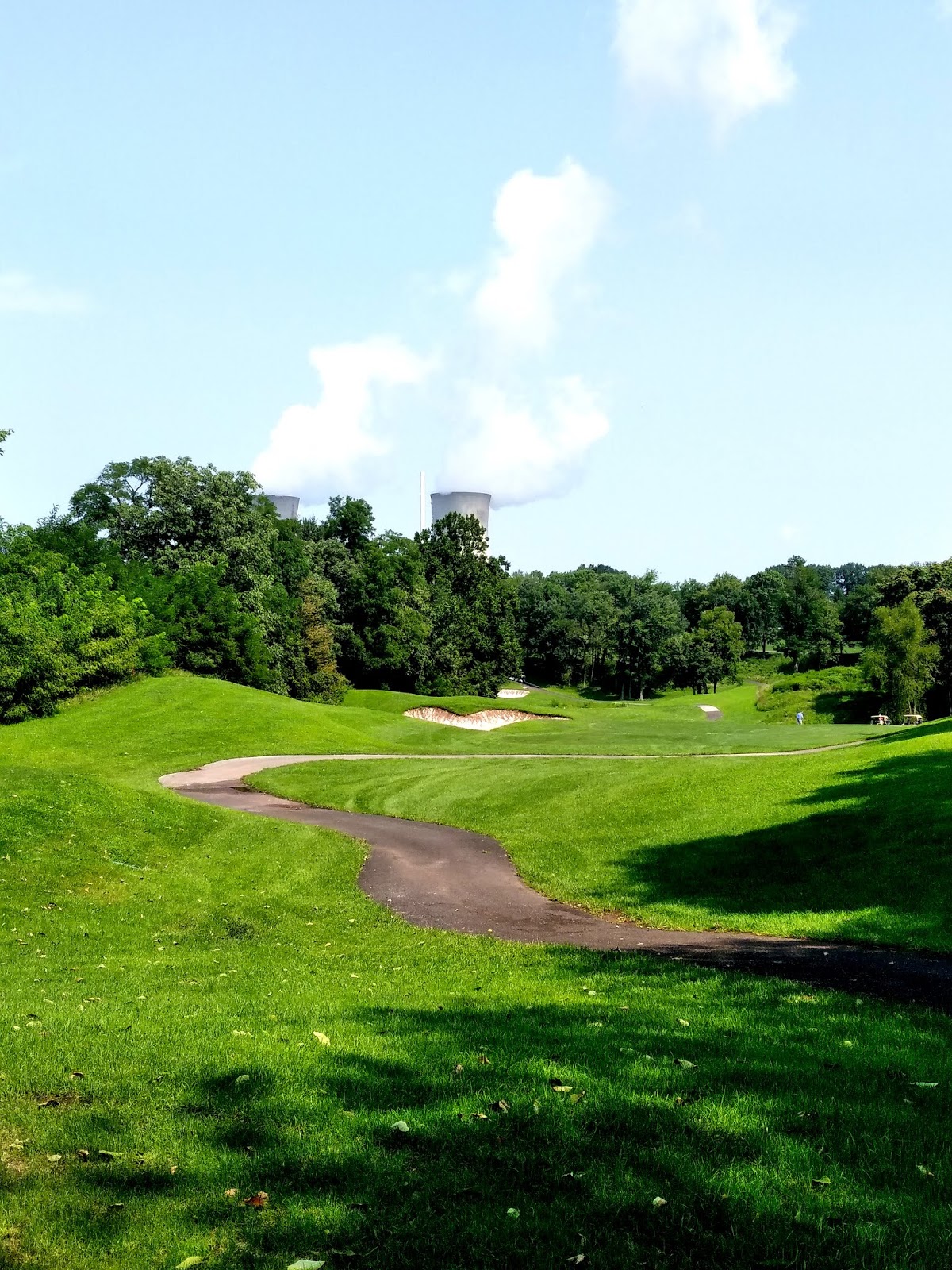
Set in Montgomery County near the nuclear power plant the steaming towers are visible from may areas around the course. This is an interesting and challenging little layout. While not overly long playing only 6365 from the back tees it's no pushover. 

Conditioning seems to be an ongoing issue but with the combination of heavy rains and hot and humid weather many area courses are experiencing similar issues on various levels. While some fairways were in rough shape the greens were just fine. They ran smooth and true while on the slow side the day I was there.

The course is packed together pretty tight and while there are trees and mounds used to separate holes some are pretty close. There are a couple holes that play tough the first time you see them but they are manageable once you break them down, like the par 5 12th hole. It has a really nice green complex but while the hole is short by par 5 standards it isn't one you go after in two unless you hit an exceptionally well placed and long tee shot in the fairway.

The designer save the only over 400 yard par 4 for your last test heading to the barn. The green is open and accessable but without a good tee shot it will take a quality second shot to find it.

The course makes good use of the rolling terrain and doesn't present many blind shots to the golfer. What it does is make you think where you want your next shot to be over just hitting for distance toward your target. Driver off every tee, even from the short tees, is not the way to play this course.


Iron Valley Golf Club in Lebanon, Pennsylvania

If I thought Linfield National was hilly my visit to Iron Valley provided a new perspective. This PB Dye (son of legendary designer Pete Dye) took this former quarry and made it into a tough challenging 18 holes of golf. I think Big Horn sheep would have been better than a golf cart to navigate some of the course.

This course challenged you right from the first hole that goes up hill to a pushed up green. Once there you lose concentration of your putt with a wonderful 360 degree vista from the green set on the highest point on the course.

After navigating the hills and contours of the first four holes Dye throws a flat 124 yard (back tee) par three at you with a smallish island green. Talk about swinging for the fences or trying to knock a single over the infielders head this change of pace throws you a curve. It's only a brief respite however with this and the relatively flat par four 6th hole.

The tee shot on the par 5 seventh needs to be well placed and then you have to figure out where to go from there as much of the landing area seems slopped severely towards a water hazard. One staffer commented that it is one of the worst holes in golf and he hasn't figured out how to play it. 

It was unfortunate that the day I played there was a company of multi groups playing just in front of us and play was very slow in addition to cart paths only and one of the hottest and most humid days we had over the summer. While after I played I was told there was staff out trying to keep those groups all moving I didn't see a Ranger on the course after the 6th hole and witnessed open holes ahead of us.

I would go back to play the course again but I would make sure it would be at a time more compatible to playing at a much improved pace.


Forsgate Country Club in Monroe Township, New Jersey

This is a private facility in Central New Jersey that was a treat to get an invite to play. I played the Banks Course that is a test at a par of 71 with a 130 slope rating. The regular members tees are set at 6379 yards over some naturally hilly terrain. It will challenge you to use every club in the bag and with a few quirks on it your mind will get a workout.

One moderate length par 3 has a bowl in the green that feeds the ball toward the hole, but there are two other levels on the green so you could have a birdie putt or be looking at a three putt. It is also surrounded by a bunker that gives the hole its name "Horseshoe."

Another par 3 that plays 216 yards from the back tee has an elongated green that almost looks like a saddle with three tiers. A forward high tier that drops about 10-15 feet to a middle lower tier then back up to an even higher back tier. It's a test from the 182 yard member tee no matter where the pin is set. Adding to that is a large bunker along the entire left side of the green that has a wooden walkway through it to the green from the cart path.

The 551 yard eighth hole is call "Long" for a reason. The fairway is like the ocean on the outskirts of a storm rolling this way and that way and after the tee shot it plays all uphill to the green.


Crossgates Country Club in Millersville, Pennsylvania

Another of the many courses in the Keystone state using the rolling terrain to its advantage. This is basically a golf course community facility right next to Millersville University. 

The course seems suited for senior and women players but that doesn't mean it's a pushover for low handicap players. As with many courses built over rolling hills just bombing the ball off the tee doesn't work because many of the holes require placement using angles, a creek that borders some holes and doglegs around trees as well as the hilly nature of the property.

The third hole is a little downhill par 3 of 118 yards from the white tee (136 from blue tee). Miss this narrow green short, left or even long and you are in trouble and might even have to reload. A miss right won't kill you but where your ball ends up depends on the bounce.

The course is only 6151 yards from the back tees and it plays very comfortable with mostly generous landing areas that don't require a driver. The greens have tilts and gentile rolls so while they look flat they really aren't. Sometimes subtle breaks are just as hard to read as those big breaking putts. We did encounter one green that shows you everything appearing tilted and sloped one way and the ball goes against what your eyes tell you. You need to test that slope with your feet walking on it.

Two holes showed up to me as a little out of place in the par 5 10th and par 5 18th. On ten the layup area seems awkward and leaves a longish uphill third shot to the green. While most of the course was comfortable and fun to play when I stepped on the 18th tee I felt I was on a different course. It plays 530 from the white tees and 450 from the senior tees but play from either tee leaves the same testing uphill shot to the green that could be as little as an eight or nine iron or a hybrid for a senior player.

All that said it was a fun course to play and it was in very good shape when I was there before we started to experience all the heavy rainfall in the area


The Shore Club

The former Wildwood Country Club under new ownership is renamed and getting a gradual facelift. The bunkering is being restored to it's more natural state from the original design while a couple of holes may get some tweaking. 


Buena Vista

asdfsdfsdfs


Stonewall, Old Course

asdfsdfsd


Broad Run Golf Club, West Chester, Pennsylvania

asdfgh


Doylestown Country Club

asdfsdf


Philmont Country Club, North Course

asdfsdfs


This is an article in process. More to come.